Oceanic Mixing from Submarine Groundwater Discharge
Abstract
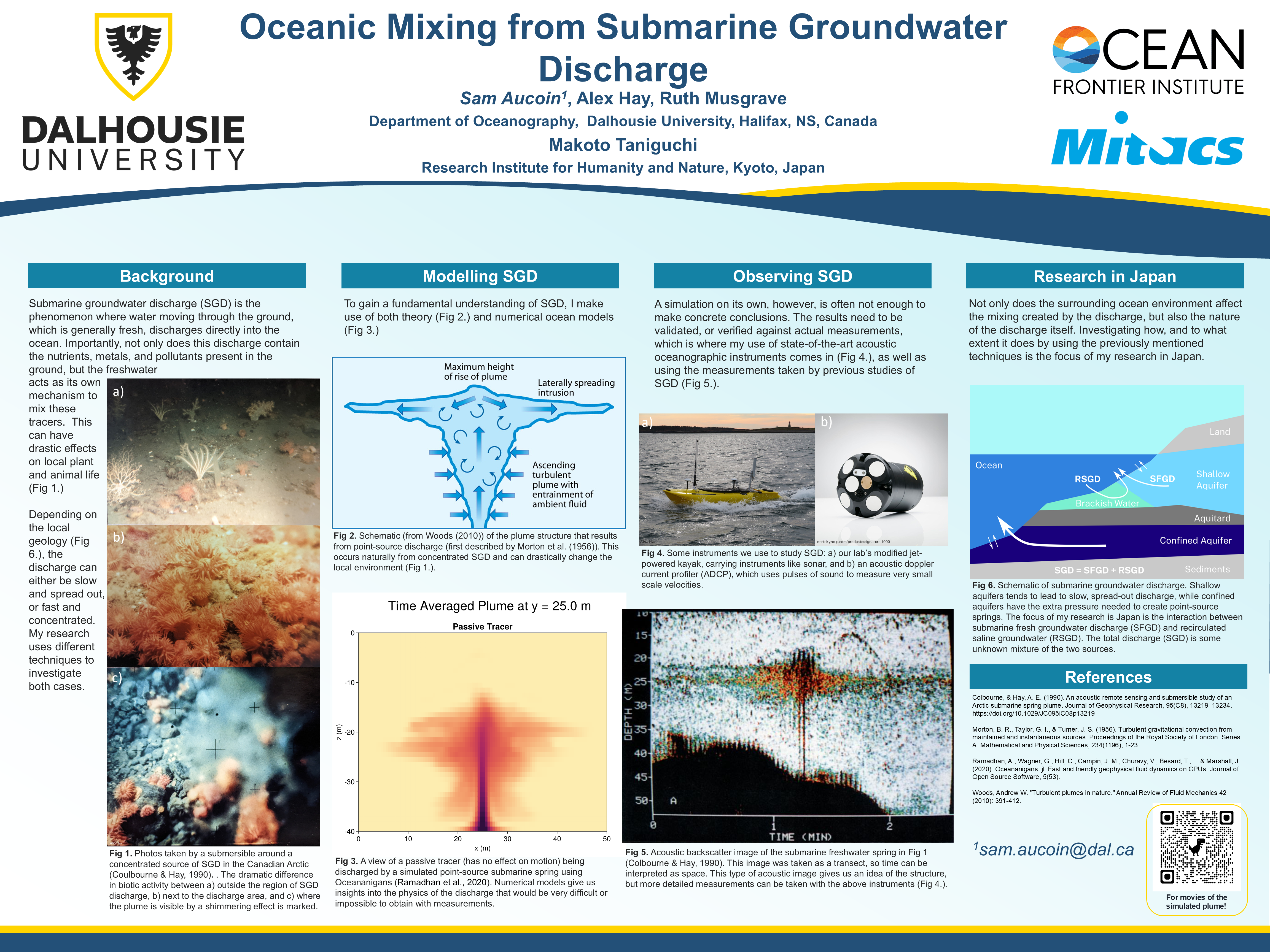
Submarine groundwater discharge (SGD) is a phenomenon in which offshore groundwater is discharged directly into the coastal ocean. Not only does this discharge contain ecologically significant nutrients and metals (Moore, Annu. Rev. Mar. Sci., 2010), but it can also mix these tracers with the surrounding environment by its own mechanism of freshwater input, altering the local biological habitat and water properties. SGD occurs in two broad categories: diffuse, and point-source discharge, neither of which are pure freshwater inputs, as seawater is entrained into the freshwater beneath the seafloor prior to discharge. To date, research on SGD has been concerned mainly with bulk estimates, rather than the specifics of the interactions between the discharge and the local environment. My research aims to fill this knowledge gap by using both state-of-the-art acoustic instruments and numerical models. My work at the Research Institute for Humanity and Nature will focus on integrating a theoretical groundwater model with an open-source Large Eddy Simulation ocean model, validated with acoustic measurements. The results will be used to investigate the impacts of recirculated seawater on the discharge structure and mixing, as well as effects of oceanic processes on the ratio of fresh-to-seawater.