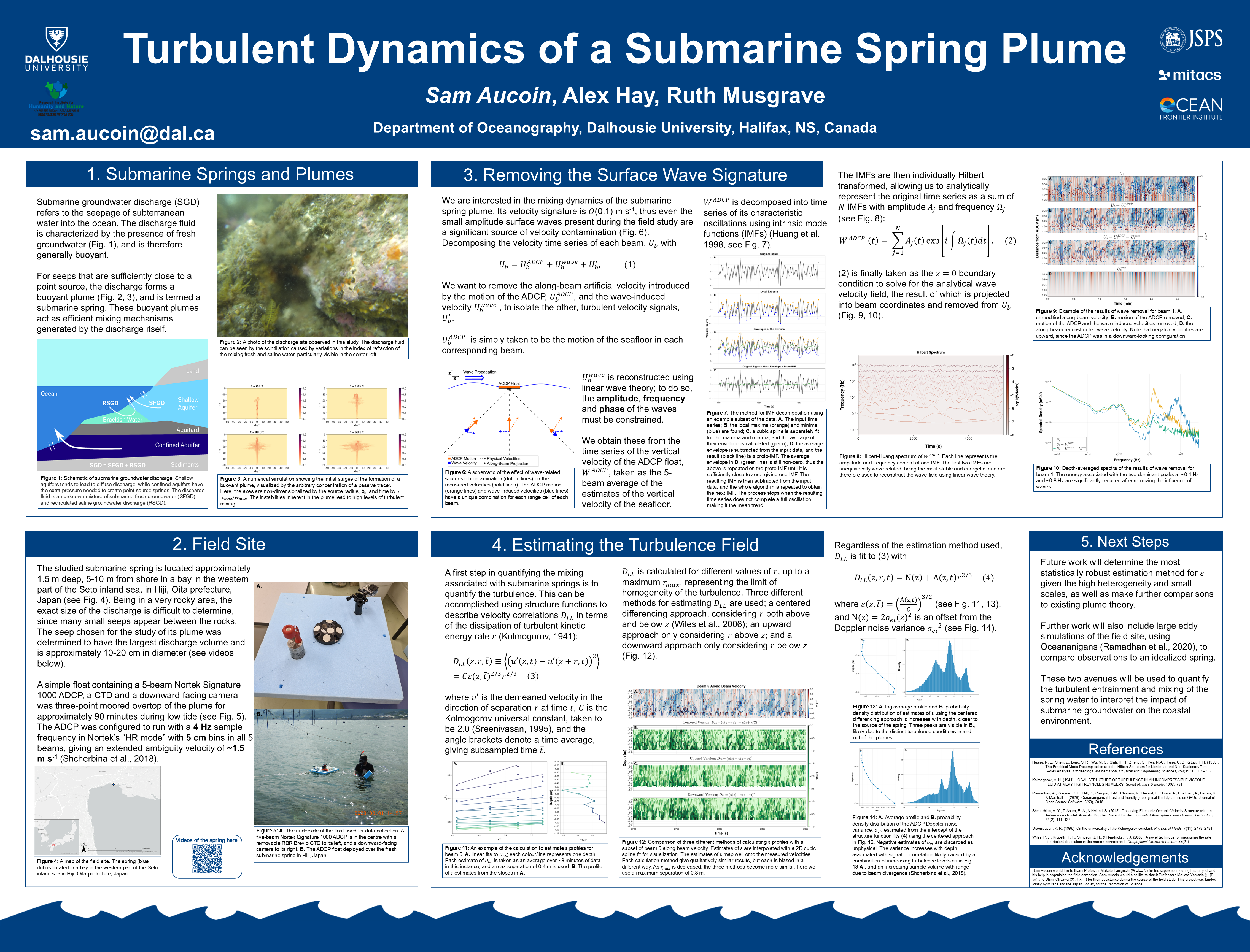
Turbulent Dynamics of a Submarine Spring Plume
Abstract
The phenomenon by which groundwater flows directly into the coastal ocean is referred to as submarine groundwater discharge (SGD). In areas with a combination of favourable geology and high enough hydraulic pressure, the seepage of groundwater can present itself as a localized source of buoyancy at the seafloor, and the resultant buoyant jet generates active turbulence and mixing. Often associated with elevated biotic activity, in part due to the elevated nutrient and metal content of the discharge, these sites present a unique system in which common coastal mixing processes are secondary to the mixing created by the source itself. One such submarine spring, located at 1-2 m depth in Hiji, Oita Prefecture, Japan, is characterized with a time series of downward-looking high resolution (5 cm) Acoustic Doppler Current Profiler (ADCP) measurements of velocity of the entire on-axis length of the spring plume. Dynamics of the plume are investigated with characterizations of on-axis levels of turbulence and dissipation of energy, as well as instabilities inherent to the plume. These characterizations are also compared with a turbulence-resolving Large Eddy Simulation (LES) of the studied plume to elucidate dynamical processes at play.